
Introduction
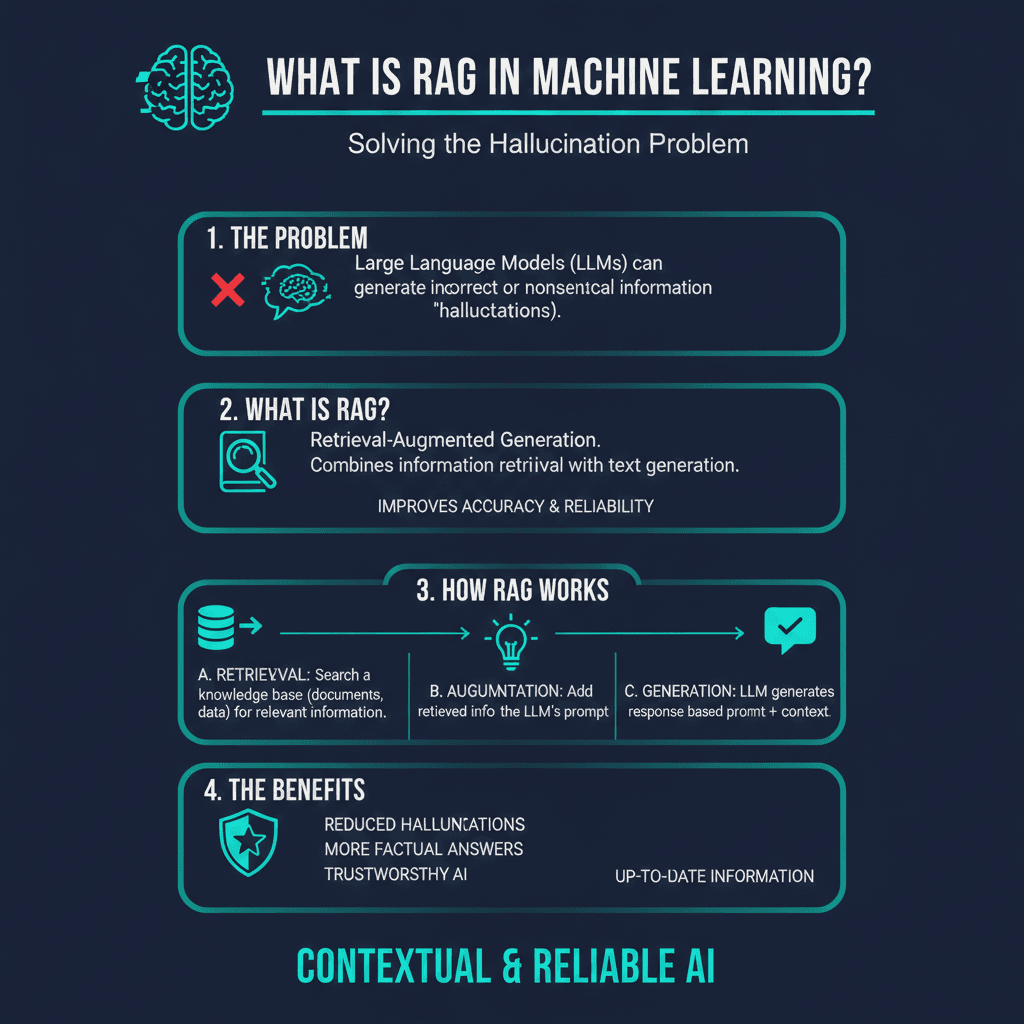
Large Language Models (LLMs) have revolutionized how businesses interact with data, yet they suffer from a critical flaw: the tendency to hallucinate. When an AI model generates information that sounds authoritative but is factually incorrect, it undermines trust and limits the utility of the technology in professional environments. To address this, developers and data scientists have turned to a powerful architectural framework known as Retrieval-Augmented Generation (RAG). By understanding what is RAG in machine learning, enterprises can transform generic AI tools into reliable, domain-specific assistants that operate on verified, private data.
Key Takeaways
- Solving AI Hallucinations Large Language Models (LLMs) have revolutionized how businesses interact with data, yet they suffer from a critical flaw: the tendency to hallucinate.
- To address this, developers and data scientists have turned to a powerful architectural framework known as Retrieval-Augmented Generation (RAG).
- By understanding what is RAG in machine learning, enterprises can transform generic AI tools into reliable, domain-specific assistants that operate on verified, private data.
- At its simplest, RAG is a methodology that connects a generative AI model to an external, private knowledge base.
The Core Concept: What is RAG in Machine Learning?
At its simplest, RAG is a methodology that connects a generative AI model to an external, private knowledge base. Standard LLMs are limited by the static data they were trained on, which creates a knowledge cutoff. If you ask a standard model about a policy change that occurred yesterday, it will likely fail or invent an answer. RAG solves this by intercepting the user query, searching a proprietary database for relevant documents, and feeding that information into the model as context. This process grounds the AI in reality, ensuring that every response is backed by specific, verifiable data.
Why Hallucinations Occur in Standard LLMs
To appreciate the value of RAG, one must understand why hallucinations happen. LLMs are probabilistic engines designed to predict the next token in a sequence. They do not have a built-in mechanism to verify facts against an external source. When a model lacks the specific information required to answer a query, it often prioritizes fluency over accuracy, resulting in a plausible but false output. For industries such as legal, healthcare, and finance, where precision is non-negotiable, this behavior is a significant barrier to adoption.
The Architecture of Retrieval-Augmented Generation
The RAG pipeline consists of three primary stages: retrieval, augmentation, and generation. First, the system converts user queries into vector embeddings, which allow for semantic search across a vector database containing your enterprise documents. Second, the system retrieves the most relevant snippets of information. Third, these snippets are injected into the prompt sent to the LLM, providing the model with the necessary context to generate an accurate, evidence-based response. This architecture ensures that the AI acts as a researcher rather than a creative writer.
Comparing Standard LLMs and RAG-Enabled Systems
For stakeholders evaluating technology services, it is vital to distinguish between a standalone model and a RAG-enabled system. The following table highlights the operational differences that drive enterprise decision-making.
| Feature | Standard LLM | RAG-Enabled System |
|---|---|---|
| Data Source | Static Training Data | Dynamic External Databases |
| Accuracy | Prone to Hallucinations | High (Grounded in Facts) |
| Updates | Requires Retraining | Real-time Data Access |
| Transparency | Opaque Reasoning | Cites Source Documents |
As shown in the table, the primary advantage of RAG is its ability to access real-time data without the need for expensive and time-consuming model retraining. This agility allows businesses to keep their AI agents updated with the latest policies, product manuals, or customer records, ensuring that the information provided to users is always current.
The Role of RAG in Custom Enterprise Solutions
At Technologies, we specialize in AI/ML product development, helping organizations implement these frameworks to ensure their software solutions remain grounded in reality. Our approach to custom software development focuses on creating a secure bridge between your internal data and the generative engine. By utilizing RAG, we can provide verifiable citations for every claim the model makes, which builds trust with customers who require precision in their automated workflows.
Enhancing Data Privacy and Security
A common concern for enterprises is the security of their proprietary data. When implementing RAG, organizations maintain control over their knowledge base. The LLM does not need to be trained on sensitive data; instead, it only accesses the specific documents retrieved during the query process. This separation of concerns is a fundamental aspect of enterprise-grade AI architecture, ensuring that sensitive information remains within the secure perimeter of the organization’s infrastructure.
Practical Applications Across Industries
The versatility of RAG allows it to be applied across various sectors. In healthcare, it can be used to query patient management systems to provide doctors with accurate, context-aware summaries. In finance, it can assist analysts by retrieving real-time market data and internal reports to support decision-making. By integrating custom software solutions with RAG, firms can move beyond basic automation into reliable, intelligent decision-making tools that scale with their specific operational needs.
Navigating the Future of AI Information Retrieval
As search technologies evolve, staying informed on how AI impacts search strategies becomes vital for maintaining a competitive edge. The shift toward RAG is part of a broader trend in the industry toward more transparent and verifiable AI interactions. Whether you are exploring how to optimize internal workflows or building customer-facing chatbots, understanding these architectural shifts is essential.
The Importance of Contextual Awareness
Context is the key to effective AI performance. A model that understands the specific nuances of your business documentation will always outperform a generic model. By mastering AI context, businesses can create agents that are not only knowledgeable but also highly relevant to their specific use cases. This level of customization is what separates successful AI implementations from those that fail to deliver value.
Strategic Implementation Steps
Implementing RAG requires a systematic approach. First, identify the high-value data sources that will provide the most benefit to your users. Second, choose the right vector database and embedding models to ensure accurate retrieval. Third, design the prompt engineering strategy to effectively utilize the retrieved context. Finally, establish a monitoring and evaluation framework to ensure the system remains accurate and reliable over time. Partnering with an experienced IT consultancy can help navigate these complexities, ensuring that your AI strategy is robust and scalable.
Conclusion
Retrieval-Augmented Generation represents a fundamental shift in how we build and deploy AI systems. By addressing the hallucination problem through the integration of external, verified knowledge bases, RAG provides the necessary guardrails for enterprise-grade AI adoption. It transforms LLMs from generic conversationalists into reliable, domain-specific experts that can handle complex, data-driven tasks with confidence. For businesses looking to leverage the power of AI while maintaining accuracy, transparency, and data privacy, RAG is not just an optional feature but a core component of modern software architecture. By grounding AI in your unique business reality, you can unlock new levels of efficiency and innovation, ensuring that your digital transformation efforts deliver tangible, long-term value. As we continue to push the boundaries of what is possible with AI, the ability to effectively retrieve and utilize information will remain the defining factor of success in the digital era.