Modern enterprises operating within the United States face a complex challenge: scaling artificial intelligence models requires more than just raw computing power. It demands a sophisticated orchestration of resources. Cloud management services for AI infrastructure provide the necessary framework to deploy, monitor, and optimize these high-performance environments. Without a structured approach, organizations often struggle with ballooning costs and inefficient resource allocation. At AllZone Technologies, we recognize that the shift toward AI-driven operations necessitates a robust backend. As a software development and IT consultancy firm, our expertise in custom enterprise solutions allows us to bridge the gap between complex hardware requirements and software agility. Whether you are building proprietary models or integrating third-party tools, managing the underlying cloud architecture is the foundation of long-term success.
Key Takeaways
- Cloud management services for AI infrastructure provide the necessary framework to deploy, monitor, and optimize these high-performance environments.
- Without a structured approach, organizations often struggle with ballooning costs and inefficient resource allocation.
- At AllZone Technologies, we recognize that the shift toward AI-driven operations necessitates a robust backend.
- Whether you are building proprietary models or integrating third-party tools, managing the underlying cloud architecture is the foundation of long-term success.
The Core Components of AI Infrastructure
Effective management involves balancing performance with cost-efficiency. This section highlights how specialized services streamline the lifecycle of AI/ML product development. By integrating automated oversight, businesses can ensure their infrastructure remains resilient under heavy computational loads. Managing these layers requires a deep understanding of both DevOps and data science workflows. When infrastructure is managed correctly, teams spend less time troubleshooting environment configurations and more time refining their AI/ML product development cycles. Ultimately, the goal of these services is to provide transparency. By implementing rigorous oversight, companies can avoid the common pitfalls of cloud sprawl. As you navigate the complexities of modern IT, remember that your infrastructure should be an asset that accelerates innovation rather than a bottleneck that drains your technical resources.
| Service Category | Primary Function | Business Impact |
|---|---|---|
| Resource Orchestration | Dynamic scaling of GPU/TPU clusters | Reduced latency in model training |
| Cost Governance | Real-time tracking of cloud spend | Optimized operational budgets |
| Security Compliance | Automated policy enforcement | Risk mitigation for sensitive data |
Operational Burden of Modern Machine Learning
To understand the necessity of these services, we must first define the operational burden of modern machine learning. AI initiatives require massive computational power, specialized hardware, and constant data flow. Without a structured approach, organizations often face runaway costs and inefficient resource utilization. This is where specialized cloud management services for AI infrastructure become essential for maintaining a competitive edge. At AllZone Technologies, we recognize that managing these environments requires more than standard IT oversight. Our approach ensures that your cloud environment scales alongside your data demands without sacrificing performance or budget.
Pillars of AI Infrastructure Management
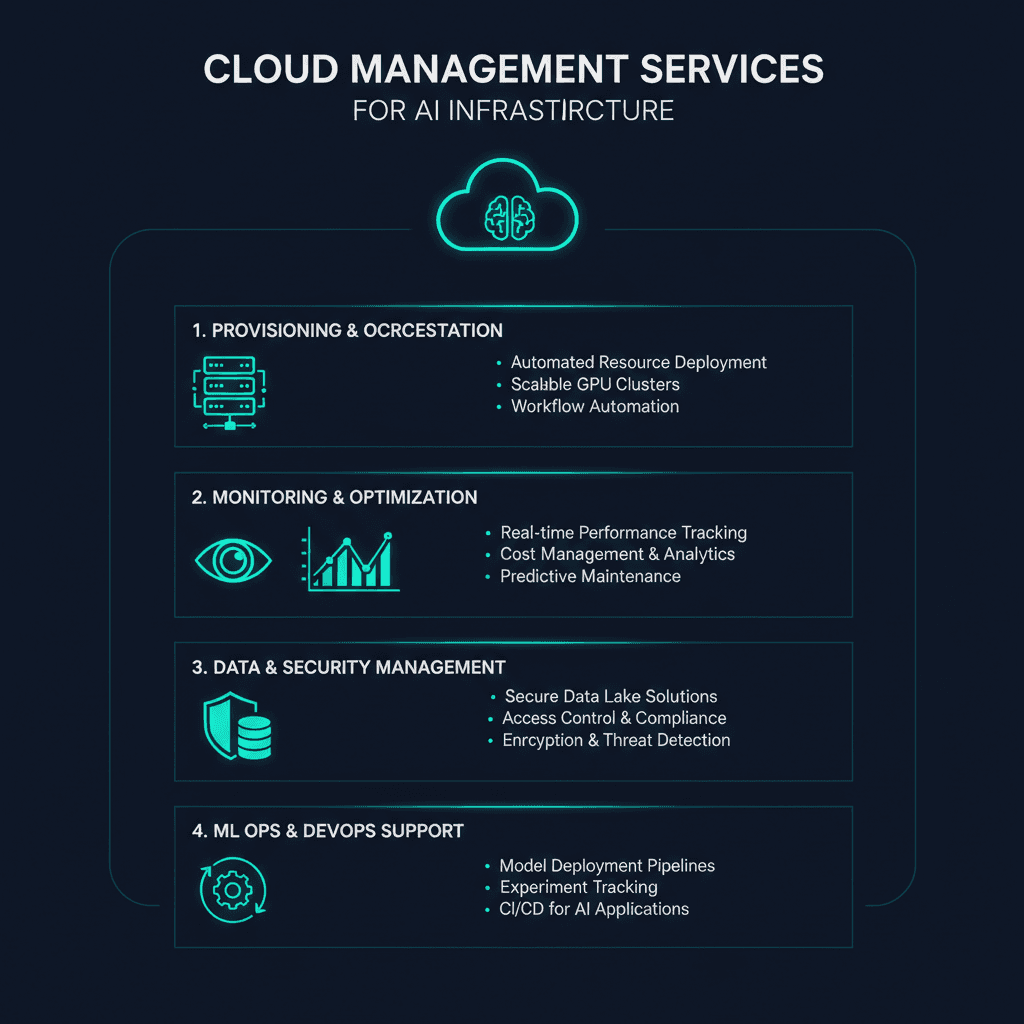
Effective management involves balancing high-performance computing with cost-effective resource allocation. When businesses attempt to scale AI models, they often struggle with idle instances and fragmented storage. Our methodology addresses these pain points through three primary pillars: resource orchestration, cost governance, and performance optimization. Resource orchestration involves automating the deployment of GPU-accelerated environments, while cost governance implements strict monitoring to prevent budget overruns during model training. Performance optimization focuses on tuning latency and throughput to ensure real-time AI responsiveness.
| Feature | Traditional IT | AI-Optimized Management |
|---|---|---|
| Resource Scaling | Manual/Static | Dynamic/Automated |
| Cost Focus | Fixed Budgeting | Usage-based FinOps |
| Hardware Needs | General Purpose | GPU/TPU Specialized |
Orchestration and Monitoring for Distributed Computing
Cloud management services for AI infrastructure involve the orchestration, monitoring, and optimization of the distributed computing resources required to train and deploy machine learning models. Without a structured approach, organizations often face runaway costs and inefficient resource allocation. AllZone approaches this challenge by integrating specialized oversight into the broader software development lifecycle. When businesses deploy AI/ML product development initiatives, they require more than just raw compute power; they need a governance layer that ensures high availability and performance. By aligning infrastructure with specific business objectives, firms can avoid the pitfalls of over-provisioning.
Operational Efficiency and Resource Fragmentation
AI projects often suffer from resource fragmentation. Without proper oversight, compute instances remain idle while storage costs balloon. By utilizing specialized technology services, organizations can automate the lifecycle of their AI assets. This ensures that GPU clusters are provisioned only when training jobs are active, significantly reducing overhead. When integrating these systems, businesses should prioritize visibility into their resource consumption. Maintaining a lean architecture is essential for long-term viability. The following table illustrates how managed services optimize specific AI infrastructure components:
| Infrastructure Component | Management Challenge | Service Solution |
|---|---|---|
| GPU Clusters | High idle costs | Auto-scaling and scheduling |
| Data Pipelines | Latency and bottlenecks | Automated workflow orchestration |
| Model Deployment | Version control drift | CI/CD integration for AI |
Strategic Implementation and Compliance
AllZone Technologies emphasizes that AI/ML product development is not a one-time setup. It is an iterative process requiring constant tuning. Custom software development allows teams to build proprietary interfaces that monitor model health and infrastructure performance simultaneously. For United States enterprises, the focus remains on compliance and data sovereignty. Managed services provide the guardrails needed to ensure that AI training environments adhere to strict security protocols. By offloading the complexity of infrastructure maintenance, internal teams can dedicate their energy to refining algorithms rather than troubleshooting server configurations. This shift in focus is what separates successful AI-driven companies from those struggling with technical debt.
Optimizing Workloads for Bottom-Line Performance
Managing high-performance computing environments requires more than basic oversight. When organizations deploy complex machine learning models, they need specialized cloud management services for AI infrastructure to ensure resource efficiency and model reliability. At Technologies, we recognize that the intersection of software development and cloud operations is where true scalability is born. AI/ML product development demands elastic compute power that fluctuates based on training cycles and inference requests. Without proper management, companies often face ballooning costs and underutilized GPU clusters. Our approach integrates custom software development with rigorous infrastructure monitoring to prevent these inefficiencies.
| Operational Pillar | Impact on AI Infrastructure |
|---|---|
| Cost Governance | Real-time tracking of GPU/TPU spend to prevent budget overruns. |
| Automated Scaling | Dynamic resource adjustment based on model training intensity. |
| Performance Tuning | Latency reduction through optimized container orchestration. |
| Security Compliance | Hardened environments for sensitive data processing. |
Conclusion
The transition to AI-driven enterprise operations is fundamentally a challenge of infrastructure management. As organizations in the United States continue to integrate advanced machine learning models into their core workflows, the demand for specialized cloud management services for AI infrastructure will only grow. By partnering with experts like Technologies, businesses can navigate the complexities of GPU orchestration, cost governance, and security compliance with confidence. We provide the technical foundation necessary to ensure that your AI initiatives are not only innovative but also scalable and cost-effective. Whether you are refining your data pipelines or deploying autonomous agents, our dedicated development teams are equipped to help you build a resilient, high-performance environment. Investing in professional cloud management is the most effective way to turn raw computational power into a sustainable competitive advantage. Contact us today to learn how our custom software development and DevOps expertise can transform your AI infrastructure into a driver of long-term business success.