RETRIEVAL · KNOWLEDGE · GROUNDED AI
Answers grounded inyour own documents.
A model that hasn't seen your documents will guess. Retrieval-augmented generation fixes that by giving the model the right passage at the right moment. The engineering is in the chunking, the ranking and the permissions, not the prompt.
CAPABILITIES
What we actually build.
Retrieval-augmented systems that ground AI answers in your own documents, data and permissions.
01
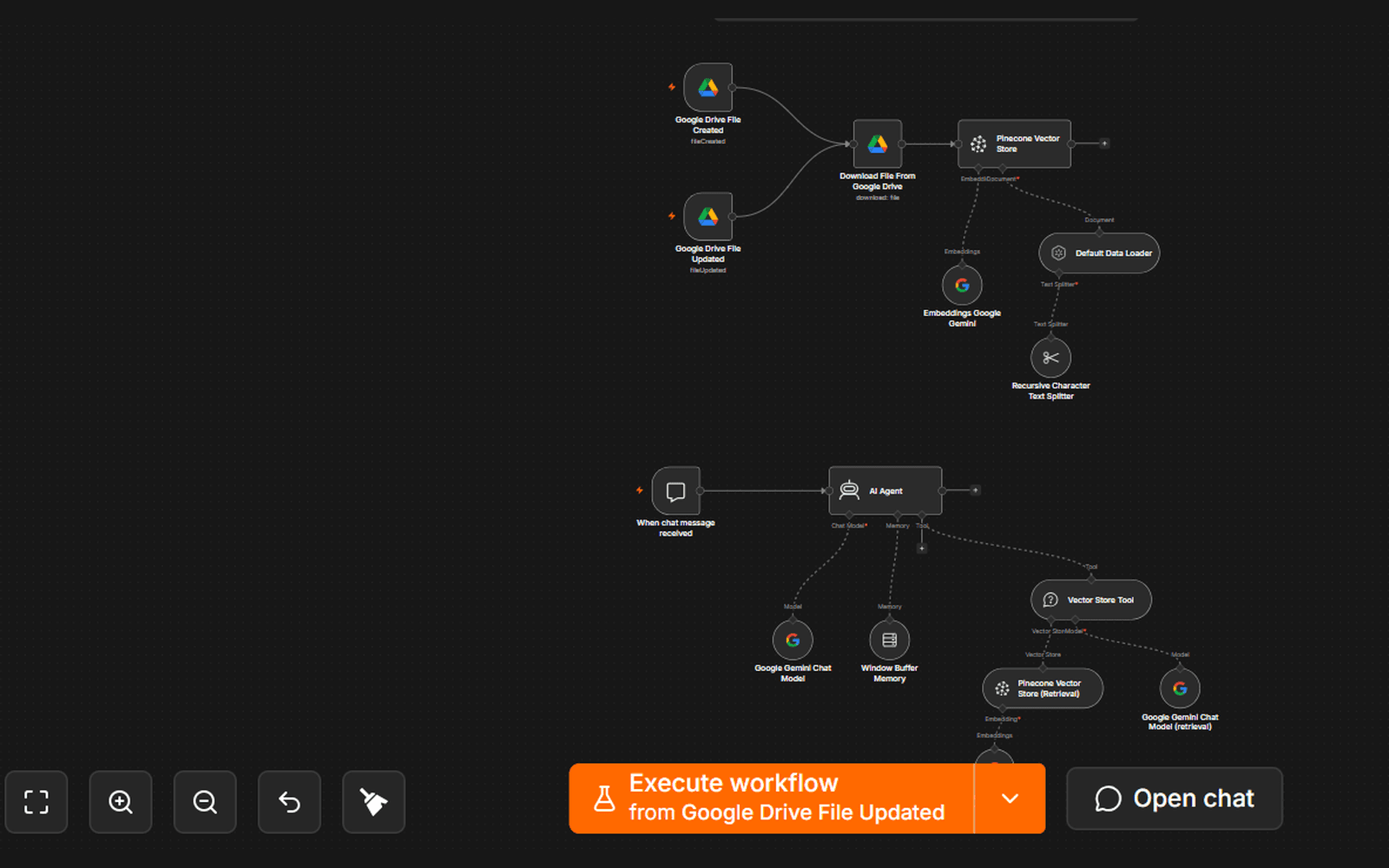
Document ingestion & chunking
Turning PDFs, wikis, tickets and structured records into passages sized and split the way a retriever actually needs them.
02
Hybrid & semantic search
Combining keyword and vector retrieval so results hold up for both exact terms and conceptual questions.
03
Vector database engineering
Indexing, scaling and maintaining the vector store an enterprise retrieval system depends on.
04
Permission-aware retrieval
Search results and generated answers respect the same access controls as the source systems, so a document a user cannot open is not retrievable either.
05
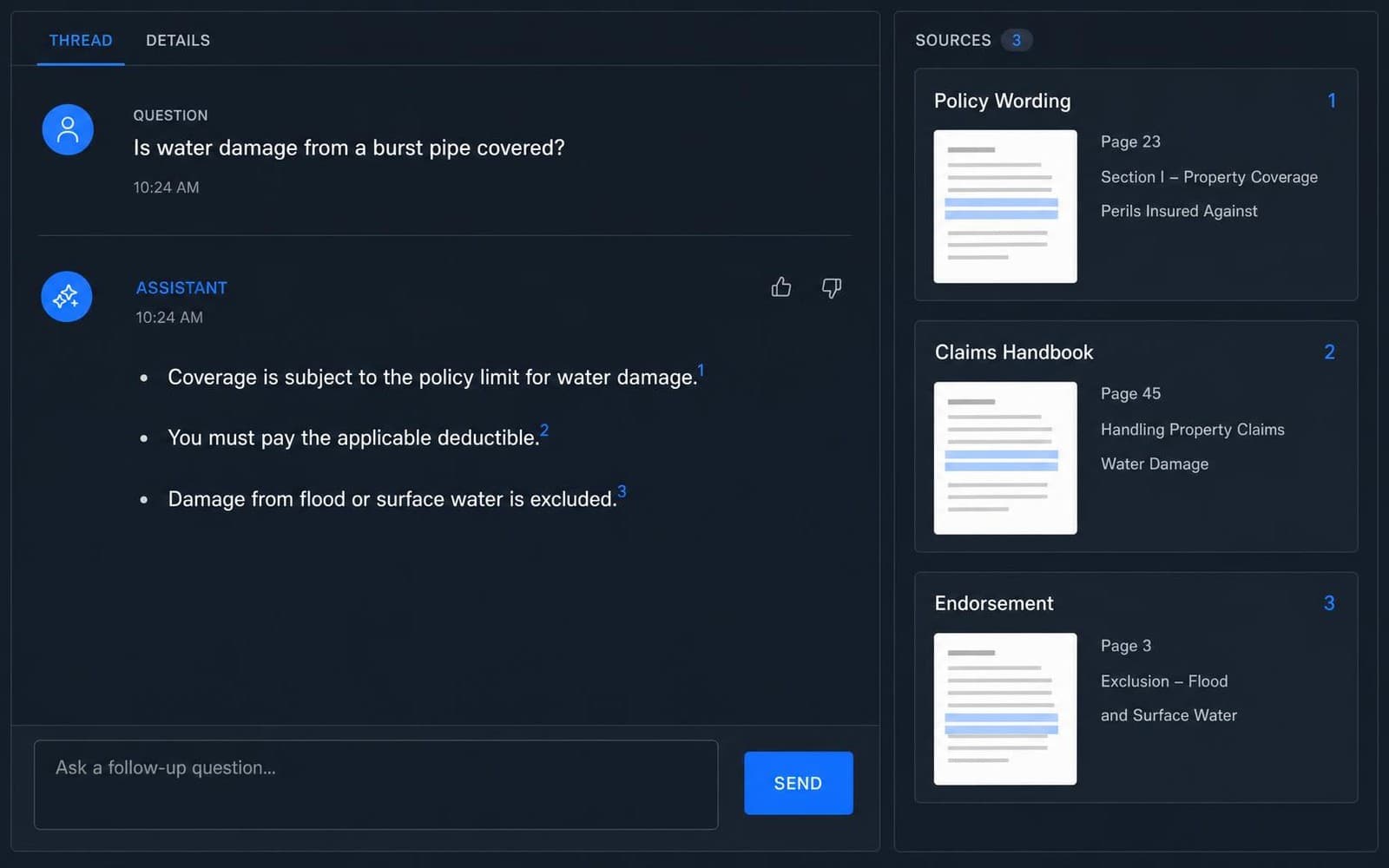
Citation & source grounding
Every answer traceable back to the passage it came from, so it can be checked rather than trusted.
06
Enterprise knowledge assistants
Internal search and Q&A over policies, documentation and historical records, built on the retrieval layer above.
07
Retrieval evaluation
Measuring whether the retriever actually surfaces the right passage, separate from whether the model writes a good answer from it.
08
Continuous re-indexing
Keeping the index current as source documents change, so answers don't quietly go stale.
OUTCOMES
What changes when this is done well.
Answers you can trace to a source
Every response points back to the document it was grounded in.
Search that understands intent
Retrieval that matches meaning, not only the exact words in the query.
Access control that survives the AI layer
The retrieval system enforces the same permissions as the systems it reads from.
Knowledge that stays current
An index that updates as the underlying documents do, instead of drifting out of date.
TECHNOLOGY
The stack we work in.
Intelligence
Model, agent and vision tooling used to build the intelligence layer.
- OpenAI
- LangChain
- Python
- PyTorch
- TensorFlow
- TensorRT
- OpenCV
- Deepgram
- ElevenLabs
- Perplexity
Data
Pipelines, storage and reporting infrastructure underneath analytics and AI.
- PostgreSQL
- MySQL
- MongoDB
- Redis
- Firebase
- Power BI
- Plotly
- Seaborn
- Dash
- Scala
Cloud & DevOps
Infrastructure, automation and the path from commit to production.
- AWS
- Azure
- Google Cloud
- Docker
- Kubernetes
- Terraform
- Jenkins
- Git
- Bitbucket
SELECTED WORK
Where this has shipped.

RELEVANT INDUSTRIES
Where domain knowledge changes the answer.
FAQ
Common questions.
Fine-tuning changes the model's weights; RAG changes what the model sees at the moment it answers, by retrieving relevant passages first. RAG is generally faster to update, since a new document is available as soon as it is indexed, and it keeps answers traceable to a source, which fine-tuning does not.
Most text-bearing sources: PDFs, wikis, tickets, contracts, structured records and exports from systems you already run. Each source needs its own ingestion and chunking approach to retrieve well, which is most of the actual engineering.
By enforcing the same access controls at retrieval time that the source systems already use, rather than relying on the model to withhold information it was shown. A document a user can't open in the source system isn't retrievable through the assistant either.
Separately from the model's writing quality. Retrieval evaluation checks whether the right passage was surfaced at all, using precision and recall against a labelled set of real queries, before ever judging the answer generated from it.
Not necessarily. The right choice depends on data volume, existing infrastructure and update frequency. Sometimes a managed vector store is right; sometimes hybrid search over infrastructure you already run is a better fit.
NEXT STEP
Tell us what you're building.
Bring us the problem with its real constraints attached. We will tell you what we would build, and what we would not.