
Introduction to How to Implement LLMs in Business: A Guide for Enterprise Leaders
The transition from experimental AI pilots to production-grade infrastructure is the defining challenge for modern organizations. Learning how to implement LLMs in business environments requires moving beyond simple prompt engineering toward robust, scalable architectures. For enterprise leaders in the United States, this shift represents a fundamental change in how software development and IT consultancy firms like AllZone Technologies approach digital transformation.
Key Takeaways
- Learning how to implement LLMs in business environments requires moving beyond simple prompt engineering toward robust, scalable architectures.
- Successful integration demands a strategic alignment between existing data silos and modern generative models.
- Companies often struggle because they treat these systems as plug-and-play tools rather than complex software assets.
- To navigate this, firms must prioritize data governance, latency management, and security protocols before deploying models into live workflows.
Successful integration demands a strategic alignment between existing data silos and modern generative models. Companies often struggle because they treat these systems as plug-and-play tools rather than complex software assets. To navigate this, firms must prioritize data governance, latency management, and security protocols before deploying models into live workflows.
The Enterprise AI Maturity Framework
Understanding the path to adoption involves recognizing where your organization sits on the maturity curve. Whether you are focused on AI/ML product development or integrating pre-trained models into legacy systems, the following table outlines the core requirements for a sustainable rollout.
| Phase | Focus Area | Enterprise Goal |
|---|---|---|
| Foundational | Data Readiness | Cleaning and structuring internal knowledge bases. |
| Operational | Custom Software Development | Building secure APIs for model interaction. |
| Advanced | Agentic Workflows | Automating multi-step business processes. |
As you begin to implement these technologies, consider the specific needs of your industry. Generic solutions rarely survive the rigors of high-compliance environments. Instead, leaders should look toward bespoke AI/ML product development that accounts for proprietary data and specific operational constraints. This ensures that the intelligence generated is both accurate and actionable.
For those preparing their infrastructure, we recommend reviewing our insights on Scaling Ai For Smart Businesses The Enterprise Ai Guide 2026. This resource provides a roadmap for managing the technical debt often associated with rapid AI adoption. By focusing on modular, secure, and scalable design, your organization can move past the hype and establish a permanent competitive advantage through intelligent automation.
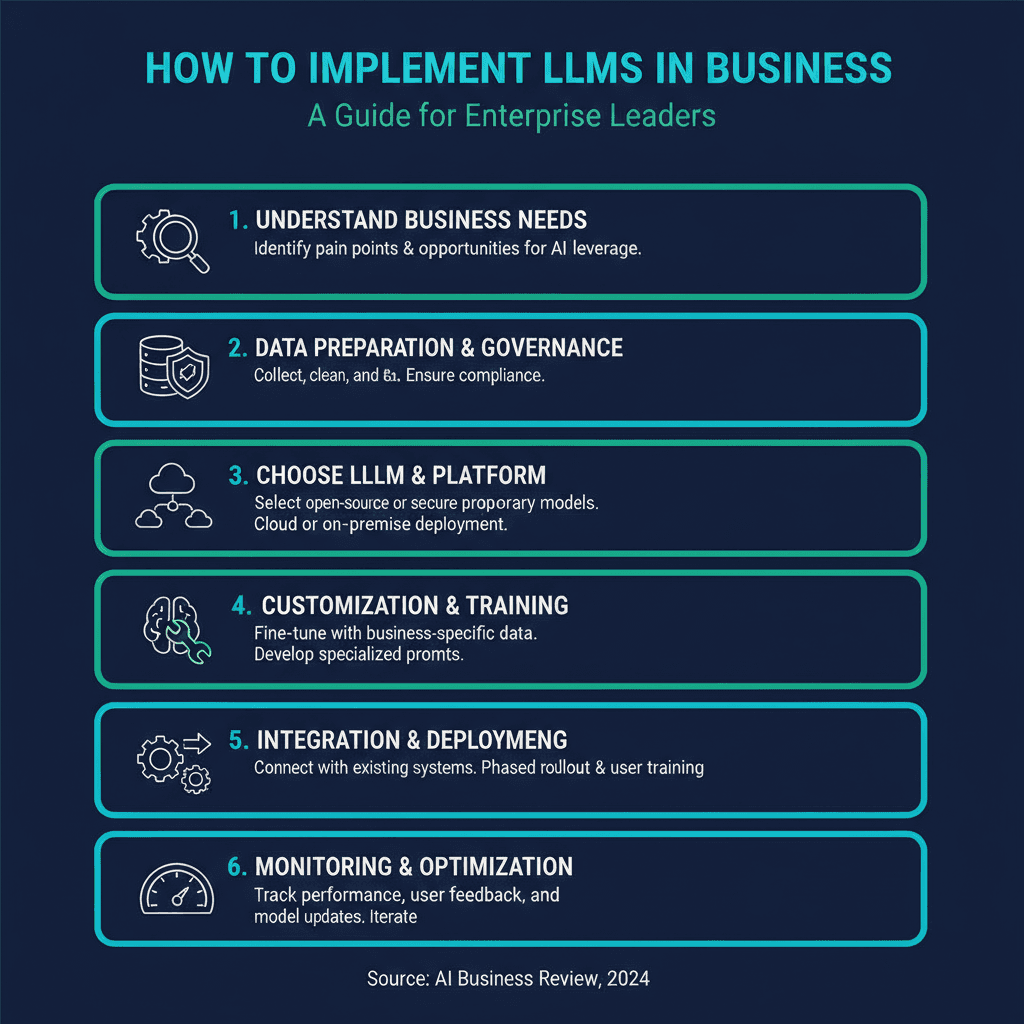
How to Implement LLMs in Business: A Guide for Enterprise Leaders
To explain how to implement llms in business clearly for customers, we must first address the architectural shift required to move from experimental AI to production-grade systems. Implementing large language models is not merely about plugging in an API; it involves integrating sophisticated neural networks into your existing data ecosystem. Firms like Technologies recognize that the primary hurdle for United States enterprises is not model access, but the alignment of these models with proprietary business logic and secure data pipelines.
When you consider how to implement LLMs in business, you are essentially building a bridge between unstructured enterprise data and actionable intelligence. This process requires a structured approach to AI/ML product development, ensuring that the model understands your specific industry vocabulary and operational constraints.
The Implementation Framework
Successful deployment follows a tiered strategy. You must evaluate your current software maturity before attempting to layer generative capabilities on top of legacy systems. For deeper insights on this transition, review our resource on Legacy Software Modernization Your 2026 Enterprise Guide.
The following table outlines the foundational requirements for a successful integration:
| Phase | Focus Area | Objective |
|---|---|---|
| Data Readiness | Governance | Clean, vectorized data sets |
| Infrastructure | Custom Software Development | Scalable API endpoints |
| Validation | Accuracy Testing | Reducing model hallucinations |
For many organizations, the path forward involves custom software development tailored to specific workflows. By focusing on high-impact use cases, such as automated customer support or internal knowledge retrieval, businesses can measure ROI more effectively. This section serves to clarify that LLMs function best when they act as specialized tools rather than generic replacements for human expertise. When you partner with an IT consultancy firm specializing in custom enterprise solutions, you ensure that the technical implementation aligns with your long-term business goals. By prioritizing data security and model fine-tuning, your organization can move beyond the hype and establish a sustainable competitive advantage through intelligent automation.
How to Implement LLMs in Business: A Guide for Enterprise Leaders.
To explain this topic clearly for customers, we must move beyond the hype and focus on the mechanics of integration. When organizations look at how to implement LLMs in business, they often fail by treating the technology as a plug-and-play solution. Instead, successful deployment requires a structured approach to data architecture and model selection.
Strategic Integration Framework
At Technologies, we emphasize that AI/ML product development is not merely about choosing a model; it is about aligning software development with specific business outcomes. Whether you are building internal knowledge bases or customer-facing interfaces, the implementation path follows a predictable technical lifecycle.
Consider the following implementation matrix to determine your readiness:
| Phase | Primary Objective | Technical Requirement |
|---|---|---|
| Data Preparation | Clean, vector-ready datasets | ETL pipelines and embedding models |
| Model Selection | Matching latency to use case | Open-source vs. proprietary API |
| Deployment | Secure, scalable infrastructure | Cloud-native orchestration |
As a software development and IT consultancy firm, we have observed that the most effective implementations prioritize custom enterprise solutions over generic wrappers. By tailoring the model to your proprietary data, you ensure that the output remains relevant to your specific industry constraints. This is a core pillar of our Scaling Ai For Smart Businesses The Enterprise Ai Guide 2026.
Operationalizing AI/ML Product Development
The transition from a proof-of-concept to a production-grade system involves rigorous testing. You must account for hallucination mitigation, token management, and cost optimization. Many firms struggle because they lack the underlying infrastructure to support high-frequency queries. By integrating custom software development with specialized AI models, enterprises can automate complex workflows that were previously manual.
Ultimately, the goal is to create a system that evolves with your business. By focusing on modular architecture, you allow for model swapping as newer, more efficient iterations emerge. This flexibility is essential for maintaining a competitive edge in the United States market, where efficiency and data privacy are paramount for long-term success.
How to Implement LLMs in Business
To explain the topic clearly for customers, we must move beyond the hype and focus on the technical architecture required for production-grade deployments. When you determine how to implement LLMs in business, the primary challenge is not the model itself, but the integration layer that connects your proprietary data to the inference engine. Firms like Technologies emphasize that successful AI/ML product development relies on a robust data pipeline that ensures context, security, and accuracy.
The Integration Framework
Implementing these systems requires a tiered approach to software architecture. You cannot simply plug a public model into your existing stack and expect enterprise-grade performance. Instead, you must build a middleware layer that manages prompt engineering, vector database retrieval, and output validation. This is where custom software development becomes the differentiator between a prototype and a scalable solution.
Consider the following technical requirements for your deployment:
- Data Vectorization: Converting internal documentation into embeddings for Retrieval-Augmented Generation (RAG).
- Latency Optimization: Managing token throughput to ensure real-time responses for end-users.
- Security Guardrails: Implementing PII masking and access control lists to prevent data leakage.
The following table outlines the essential components for a standard enterprise LLM deployment:
| Component | Function |
|---|---|
| Vector Database | Stores and retrieves domain-specific knowledge. |
| Orchestration Layer | Manages the flow between user queries and model inference. |
| Evaluation Framework | Tests model outputs against accuracy benchmarks. |
For organizations looking to modernize their infrastructure, understanding how these pieces fit together is vital. You can find more context on this transition in our guide on Legacy Software Modernization Your 2026 Enterprise Guide. By focusing on modular architecture, you ensure that your business remains agile as model capabilities evolve. This section serves as the foundation for your technical strategy, ensuring that your investment in AI/ML product development yields measurable operational improvements rather than just technical debt.
How to implement LLMs in business requires a shift from experimental prototypes to robust, production-ready architectures. To explain this topic clearly for customers, we must focus on the integration of Large Language Models into existing workflows without disrupting core operations. Firms like Technologies emphasize that success hinges on data governance and the selection of appropriate model deployment strategies.
Strategic Deployment Framework
When deploying AI/ML product development solutions, enterprise leaders should prioritize modularity. Rather than building a monolithic system, integrate LLMs as specialized services that communicate via secure APIs. This approach allows your team to swap models as technology evolves, ensuring your infrastructure remains agile.
Consider the following implementation matrix to align your technical requirements with business outcomes:
| Deployment Phase | Technical Focus | Business Objective |
|---|---|---|
| Data Preparation | Vectorization & Cleaning | Accuracy & Contextual Relevance |
| Model Selection | Open-source vs. Proprietary | Cost vs. Performance Optimization |
| Integration | API/Middleware Orchestration | Seamless Workflow Automation |
| Monitoring | Latency & Hallucination Checks | Reliability & Trust |
Operationalizing Custom Solutions
Custom software development serves as the backbone for these deployments. By tailoring the model to your specific domain, whether it involves legal document analysis or automated customer support, you reduce the risk of generic, inaccurate outputs. For organizations looking to modernize their existing stack, refer to Legacy Software Modernization Your 2026 Enterprise Guide to understand how to bridge the gap between old systems and new AI capabilities.
Effective implementation relies on a feedback loop. Your technical team must establish clear metrics for model performance. If the system fails to provide value, the issue often lies in the quality of the prompt engineering or the underlying data architecture rather than the model itself. By maintaining a focus on high-quality training sets and rigorous testing, businesses can transform LLMs from simple chatbots into high-value enterprise assets. This methodical approach ensures that your investment yields measurable returns while maintaining the security standards required by modern United States enterprises.
To explain this topic clearly for customers, we must look at the practical deployment phase. Successfully integrating large language models requires more than just API access; it demands a robust architecture that aligns with your existing infrastructure. At Technologies, we focus on bridging the gap between experimental AI and production-ready software.
Operationalizing AI for Enterprise Growth
The transition from a pilot program to an enterprise-wide solution requires rigorous testing. Many organizations struggle because they treat AI as a standalone feature rather than an integrated component of their digital ecosystem. By focusing on Scaling Ai For Smart Businesses The Enterprise Ai Guide 2026, leaders can ensure that their technical services provide long-term value.
We emphasize three pillars during the implementation process:
- Data Governance: Ensuring that proprietary information remains isolated from public training sets.
- Customization: Fine-tuning models on domain-specific datasets to improve output relevance.
- Monitoring: Establishing automated feedback loops to track model drift and performance degradation over time.
By following this structured path, your organization avoids the technical debt often associated with rapid AI adoption. Our team at Technologies specializes in these custom enterprise solutions, ensuring that your transition to intelligent automation is both secure and efficient. Focus on building a foundation that supports future iterations, as the technology landscape continues to evolve at a rapid pace.