
Introduction to How to Build an AI Agent: A Step-by-Step Technical Roadmap
The transition from static language models to autonomous systems represents the next frontier in enterprise software. Learning how to build an ai agent requires moving beyond simple prompt engineering toward architecting systems capable of reasoning, tool usage, and iterative decision-making. Unlike standard chatbots, an agent functions as an independent operator that perceives its environment, processes complex logic, and executes multi-step tasks to achieve specific business outcomes.
Key Takeaways
- Learning how to build an ai agent requires moving beyond simple prompt engineering toward architecting systems capable of reasoning, tool usage, and iterative decision-making.
- Whether you are automating internal workflows or creating customer-facing solutions, the technical roadmap remains consistent.
- The Core Components of Agentic Architecture To successfully build a functional agent, developers must address four primary technical pillars.
- These components ensure that the system remains reliable when deployed in production environments.
At Technologies, we recognize that the shift toward autonomous systems is not merely about integrating an API; it is about building a robust framework that handles state management, memory, and error recovery. Whether you are automating internal workflows or creating customer-facing solutions, the technical roadmap remains consistent. You must define the agent's persona, select an appropriate orchestration layer, and integrate the necessary tools to bridge the gap between model intelligence and real-world execution.
The Core Components of Agentic Architecture
To successfully build a functional agent, developers must address four primary technical pillars. These components ensure that the system remains reliable when deployed in production environments.
| Component | Technical Function |
|---|---|
| Brain (LLM) | The reasoning engine that interprets intent and plans actions. |
| Memory | Short-term context windows and long-term vector database storage. |
| Tools | APIs, database connectors, and search functions for external data. |
| Planning | Chain-of-thought processing and sub-task decomposition. |
As you begin this step-by-step journey, focus on the orchestration layer. This is where your software development strategy meets AI/ML product development. By establishing a clear hierarchy of operations, you prevent the common pitfalls of hallucination and infinite loops. For organizations looking to scale these capabilities, understanding the nuances of Mastering Ai Agent Orchestration For Enterprise Systems is essential for maintaining system stability.
This guide serves as your technical manual for navigating the complexities of modern AI development. By following these structured phases, you will move from a conceptual prototype to a production-ready system capable of handling complex enterprise demands.
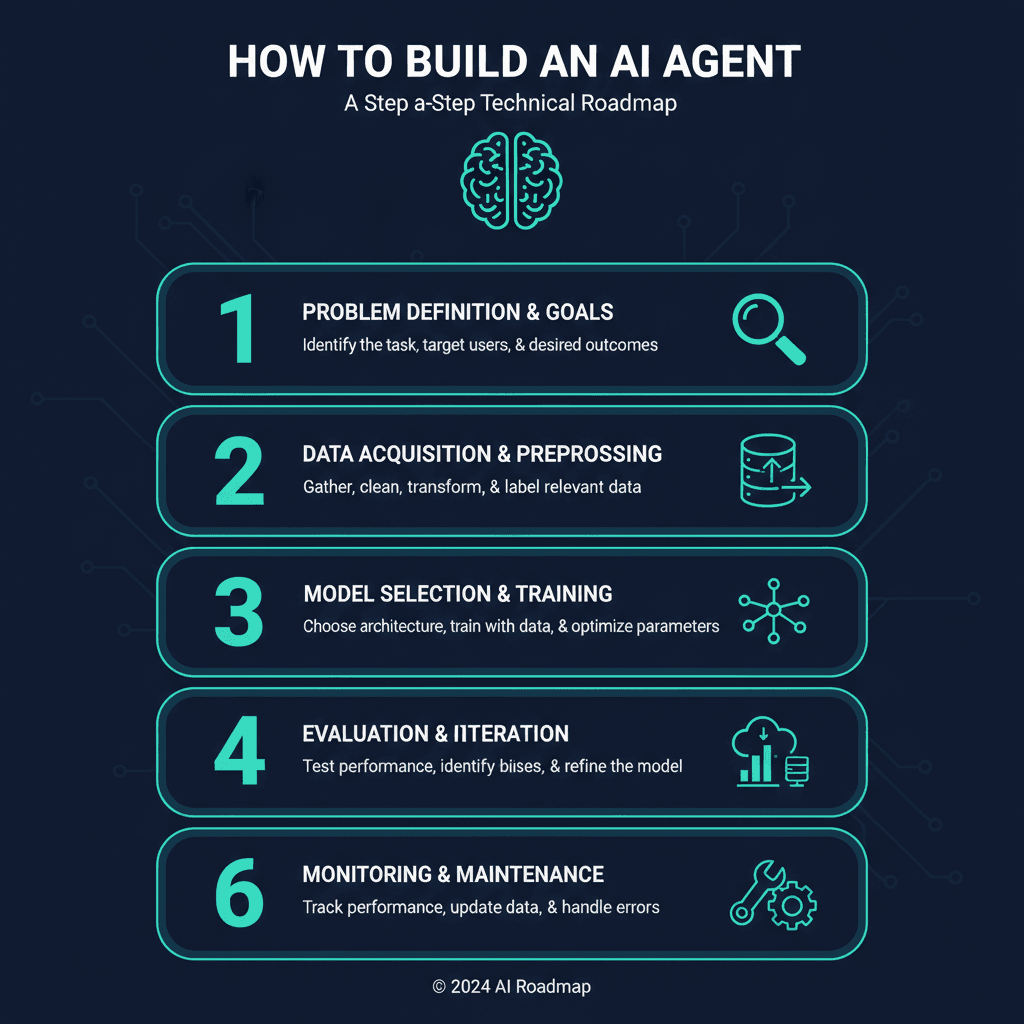
Section 2
To understand how to build an AI agent, you must first define the architectural boundaries of your system. An autonomous agent is not merely a chatbot; it is a goal-oriented software entity capable of perceiving its environment, reasoning through complex logic, and executing multi-step tasks without constant human intervention. For enterprise clients, this requires a shift from simple prompt engineering to robust systems engineering.
Defining the Core Architecture
When we explain how to build an ai agent clearly to our customers, we emphasize that an effective agent relies on four primary pillars: the brain (LLM), the memory (vector databases), the tools (API integrations), and the planning module. At Technologies, we specialize in custom enterprise solutions that integrate these components into a cohesive workflow. Whether you are automating supply chain logistics or customer support, the agent must be grounded in your specific business data.
The following table outlines the technical components required for a production-ready agent:
| Component | Function | Technical Requirement |
|---|---|---|
| Reasoning Engine | Processes inputs and plans actions | LLM (GPT-4, Claude 3.5, or Llama 3) |
| Memory Store | Retains context and historical data | Vector Database (Pinecone, Milvus) |
| Tool Interface | Executes external commands | REST APIs, Python Function Calls |
| Orchestrator | Manages state and task flow | LangGraph, AutoGen, or Custom Logic |
Strategic Implementation
Building these systems requires more than just code; it requires a deep understanding of AI/ML product development. Many organizations struggle because they attempt to build monolithic agents that try to solve too many problems at once. Instead, we recommend a modular approach where specialized agents handle distinct domains, a strategy often explored in our guide on Mastering Ai Agent Orchestration For Enterprise Systems.
By breaking down the development process into discrete phases, you ensure that the agent remains reliable and scalable. Start by defining the specific scope of the agent’s autonomy. If the agent is meant to manage customer inquiries, it must have read-write access to your CRM via secure APIs. If it is designed for data analysis, it requires a sandbox environment to execute code safely. This granular control is what separates a prototype from a high-performance enterprise asset.
Section 3
To understand how to build an AI agent, you must first define the architectural framework that governs its decision-making process. At Technologies, we approach this by separating the agent’s "brain", the Large Language Model (LLM), from its "hands," which are the tools and APIs it uses to execute tasks. For customers looking to integrate these systems, the process begins with selecting the right orchestration layer.
Defining the Agentic Workflow
An effective agent requires a structured loop of perception, reasoning, and action. Unlike standard chatbots that simply respond to prompts, an autonomous agent must evaluate its environment, determine if it has sufficient information, and decide which external function to call. We explain how to build an ai agent clearly by breaking down the core components required for a production-ready system:
- The Reasoning Engine: The LLM core that interprets user intent and plans sub-tasks.
- Tool Integration: Secure API connectors that allow the agent to read databases, send emails, or update CRM records.
- Memory Management: A vector database that stores historical context, ensuring the agent remains consistent across long-running sessions.
Technical Comparison of Agent Architectures
Choosing the right framework depends on your specific business requirements. The following table highlights the differences between common approaches to building autonomous systems.
| Architecture Type | Primary Use Case | Complexity Level |
|---|---|---|
| ReAct (Reason + Act) | Task-oriented automation | Moderate |
| Plan-and-Solve | Complex, multi-step workflows | High |
| Multi-Agent Systems | Enterprise-scale operations | Very High |
For organizations moving beyond simple prototypes, AI agent startups building production-ready autonomous AI systems demonstrate that the secret lies in robust error handling. If an agent fails to execute a tool, it must be programmed to self-correct or escalate to a human supervisor. By focusing on custom software development and specialized AI/ML product development, our team ensures that the logic governing these agents is both transparent and auditable, providing the reliability that modern enterprises demand.
Section 4
To explain the topic clearly for customers, we must look at the architectural foundation required to move from a basic chatbot to a functional autonomous system. When you determine how to build an AI agent, you are essentially designing a decision-making loop that connects a Large Language Model (LLM) to external tools and data environments.
The Core Architecture of Autonomous Agents
A production-ready agent requires more than just a prompt. It needs a structured framework that allows the system to perceive, reason, and act. At Technologies, our approach to AI/ML Product Development focuses on three distinct layers:
- The Brain (LLM): The reasoning engine that interprets user intent and breaks down complex tasks into sub-tasks.
- The Memory (Vector Databases): Long-term storage that allows the agent to recall past interactions and specific enterprise knowledge.
- The Tools (API Integrations): The functional layer that allows the agent to execute code, query databases, or interact with third-party software.
For enterprise clients, the complexity often lies in the orchestration layer. You can learn more about this process in our guide on Mastering Ai Agent Orchestration For Enterprise Systems. Without proper orchestration, agents suffer from hallucination or execution loops that drain compute resources.
Technical Comparison of Agent Frameworks
Choosing the right stack is a foundational step. The following table highlights the differences between common approaches to building these systems:
| Approach | Primary Use Case | Complexity Level |
|---|---|---|
| ReAct Pattern | Reasoning and acting in sequence | Moderate |
| Plan-and-Execute | Complex, multi-step workflows | High |
| Multi-Agent Systems | Specialized, collaborative tasks | Very High |
As a software development and IT consultancy firm, we emphasize that the most effective agents are those built with modularity in mind. By separating the reasoning logic from the tool-calling interface, developers can update the underlying model without rebuilding the entire integration suite. This ensures that as technology evolves, your custom enterprise solution remains stable and scalable.
Architecting the Cognitive Core and Tool Integration
To explain the topic clearly for customers, we must look at how the cognitive core functions as the brain of your autonomous system. When you learn how to build an AI agent, you are essentially designing a decision-making loop that connects a Large Language Model (LLM) to external data sources and execution environments. At Technologies, we emphasize that an agent is only as effective as its ability to interact with your existing enterprise software stack.
Comparative Analysis of Integration Methods
Selecting the right integration path depends on your current infrastructure. The table below outlines common approaches for connecting your agent to business systems.
| Integration Type | Complexity | Best Use Case |
|---|---|---|
| REST API Wrappers | Low | Standard SaaS connectivity |
| Custom Middleware | Medium | Legacy system data extraction |
| Direct Database Access | High | Real-time analytical processing |
For organizations seeking to scale, Mastering AI Agent Orchestration For Enterprise Systems is a necessary step to ensure security and reliability. By utilizing custom software development, firms can bridge the gap between raw LLM capabilities and specific business outcomes. Whether you are automating customer support or streamlining internal data retrieval, the focus remains on building modular, testable components that integrate seamlessly with your existing technology services.
Section 6
To explain the topic clearly for customers, we must look at the transition from static scripts to autonomous workflows. When you learn how to build an AI agent, the architecture shifts from simple input-output models to systems capable of reasoning, tool use, and memory management. At Technologies, we emphasize that an effective agent requires a robust orchestration layer to manage task decomposition and error handling.
Practical Implementation Strategy
Start by defining the agent’s "persona" and its specific operational constraints. An agent designed for customer support requires different guardrails than one built for data analysis. By utilizing custom software development practices, you can wrap these agents in secure environments that prevent hallucinations and unauthorized API calls.
Our team at Technologies specializes in AI/ML product development, ensuring that these agents integrate seamlessly into your existing enterprise stack. Whether you are automating internal documentation or building customer-facing interfaces, the goal is to maintain high-fidelity performance while minimizing latency. By focusing on modularity, you ensure that your agent remains maintainable as your business requirements evolve.
Section 7
Scaling Your Autonomous Infrastructure
Once you understand how to build an AI agent, the transition from a functional prototype to a production-grade system requires rigorous orchestration. Many organizations struggle to maintain stability when scaling these systems across complex enterprise environments. To explain how to build an ai agent clearly for customers, we must focus on the architecture that supports long-term reliability.
At Technologies, we emphasize that an agent is only as effective as its underlying data pipeline. Our approach to AI/ML product development ensures that your autonomous systems remain performant under heavy load. Whether you are automating customer support workflows or internal data processing, the integration layer must be robust enough to handle high-frequency API calls and real-time state management.
Technical Considerations for Enterprise Deployment
Deploying these systems involves more than just writing code; it requires a strategic framework for monitoring and iterative improvement. You should prioritize modular design, allowing individual components of your agent, such as the reasoning engine or the tool-use module, to be updated independently without disrupting the entire workflow. For deeper insights into this process, explore our resources on Mastering Ai Agent Orchestration For Enterprise Systems.
The following table outlines the core requirements for moving your agent from development to a live production environment:
| Requirement | Technical Focus | Business Impact |
|---|---|---|
| Latency Optimization | Model quantization and edge caching | Improved user experience |
| Security Protocols | Role-based access and data encryption | Regulatory compliance |
| Observability | Real-time logging and error tracking | Reduced downtime |
As you refine your deployment strategy, consider how your custom software development needs align with your long-term automation goals. By partnering with experts who specialize in AI/ML product development, you ensure that your technical roadmap remains aligned with your business objectives. This partnership allows your team to focus on high-level strategy while we manage the complexities of building and maintaining scalable, autonomous AI systems that deliver measurable value to your customers.