
Introduction to Custom AI Agent Orchestration for Enterprise Workflows
Modern business environments are shifting from simple automation to complex, autonomous ecosystems. Custom AI agent orchestration for enterprise represents the next evolution in this transition, moving beyond single-task bots toward interconnected systems capable of reasoning, planning, and executing multi-step business processes. At AllZone Technologies, we define this orchestration as the strategic management of specialized AI agents that collaborate to solve high-value operational challenges.
Key Takeaways
- At Technologies, we define this orchestration as the strategic management of specialized AI agents that collaborate to solve high-value operational challenges.
- Unlike standard software automation, an orchestrated agent framework allows individual AI units to share context, hand off tasks, and verify outputs in real-time.
- The Core Components of Orchestrated AI Successful implementation requires a shift in how firms approach custom software development .
- It is no longer enough to deploy a standalone model; organizations must build a cohesive environment where agents function as a unified workforce.
Unlike standard software automation, an orchestrated agent framework allows individual AI units to share context, hand off tasks, and verify outputs in real-time. This creates a resilient architecture where human oversight is reserved for high-level decision-making, while the heavy lifting of data synthesis and workflow execution happens autonomously.
The Core Components of Orchestrated AI
Successful implementation requires a shift in how firms approach custom software development. It is no longer enough to deploy a standalone model; organizations must build a cohesive environment where agents function as a unified workforce. The following table illustrates the functional differences between traditional automation and orchestrated agent systems.
| Feature | Traditional Automation | Orchestrated AI Agents |
|---|---|---|
| Decision Logic | Hard-coded rules | Dynamic, context-aware reasoning |
| Adaptability | Low (breaks on change) | High (self-correcting) |
| Workflow Scope | Linear/Siloed | Cross-functional/Integrated |
Why Enterprise Strategy Demands Custom Solutions
Off-the-shelf tools often fail to integrate with legacy infrastructure or meet the specific security requirements of large-scale operations. As a consultancy firm specializing in AI/ML product development, we recognize that true efficiency comes from tailoring the orchestration layer to the unique data silos of the business. By building custom frameworks, enterprises gain several distinct advantages:
- Granular Control: Define specific guardrails for how agents interact with sensitive internal databases.
- Scalability: Deploy additional agents to handle peak demand without re-architecting the entire system.
- Interoperability: Connect disparate software tools through a centralized agent controller.
By focusing on custom technology services, businesses ensure that their AI deployment is not just an experimental project, but a robust component of their core infrastructure. This approach transforms how teams interact with data, turning static reports into active, agent-driven insights that drive measurable growth.
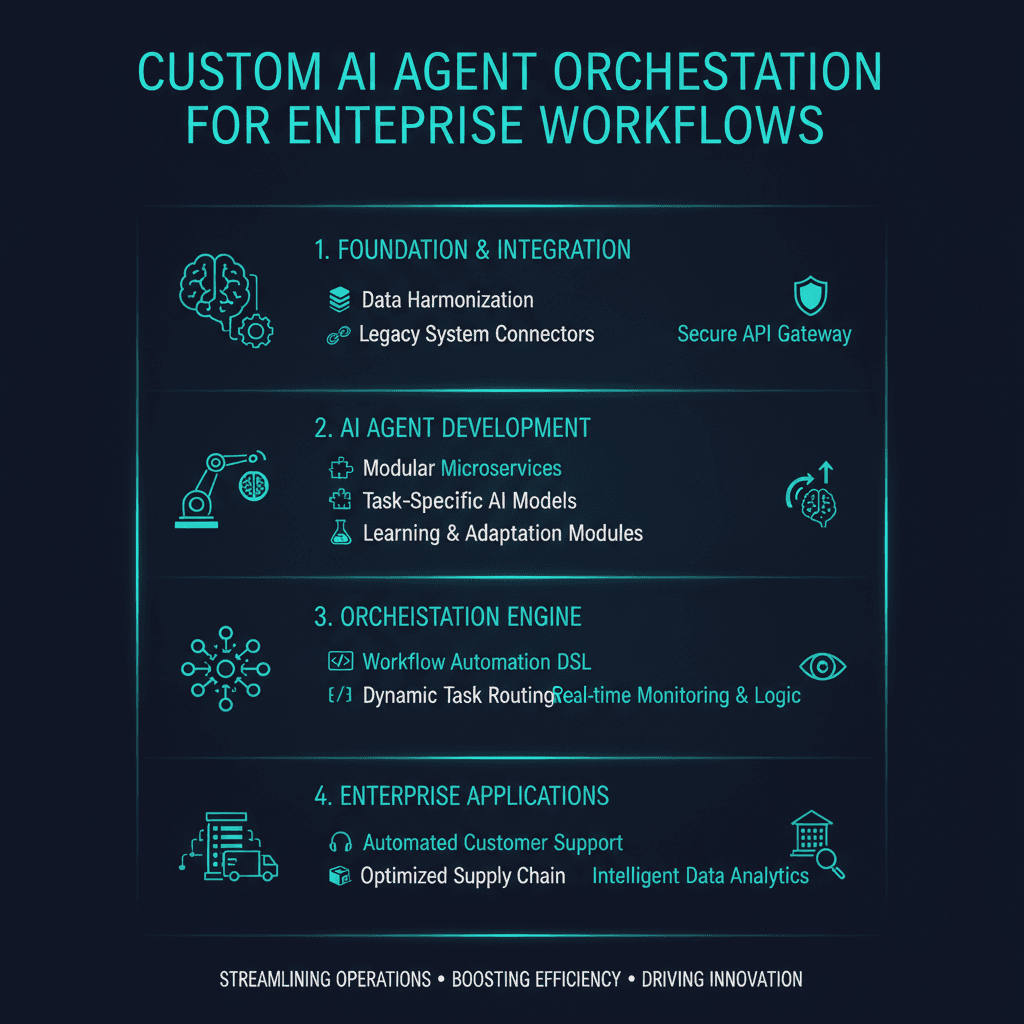
Section 2
Article title: Custom AI Agent Orchestration for Enterprise Workflows.
To explain the topic clearly for customers, we must first define what happens when isolated AI models meet complex business requirements. At Technologies, we view custom AI agent orchestration for enterprise as the connective tissue that transforms individual machine learning models into a cohesive, autonomous workforce. Rather than relying on a single, monolithic model, orchestration allows multiple specialized agents to communicate, delegate tasks, and execute multi-step processes without human intervention.
The Mechanics of Multi-Agent Systems
In a typical enterprise environment, data silos prevent efficiency. Orchestration solves this by creating a structured hierarchy where agents act as functional units. For instance, one agent might handle data ingestion, while another performs sentiment analysis, and a third triggers a CRM update. By utilizing Mastering Ai Agent Orchestration For Enterprise Systems, businesses ensure that these agents operate within defined guardrails, maintaining data integrity and security.
The following table outlines how orchestration shifts the paradigm from simple automation to intelligent workflow management:
| Feature | Standard Automation | Custom AI Orchestration |
|---|---|---|
| Decision Making | Rule-based (If/Then) | Context-aware (Probabilistic) |
| Flexibility | Rigid/Static | Adaptive/Dynamic |
| Task Scope | Single-function | Multi-agent collaboration |
Why Custom Development Matters
Off-the-shelf solutions often fail to address the nuances of proprietary enterprise data. As a firm specializing in AI/ML product development and custom software development, we recognize that every organization possesses a unique operational DNA. Orchestration is not a one-size-fits-all implementation. It requires a tailored architecture that integrates seamlessly with your existing technology stack.
By building custom frameworks, we enable your enterprise to:
- Reduce latency in cross-departmental data handoffs.
- Improve accuracy by assigning tasks to agents optimized for specific domains.
- Maintain full visibility into agent decision-making logs for compliance.
When you invest in these technology services, you are moving beyond simple software deployment. You are creating a scalable ecosystem where AI agents function as specialized employees, capable of handling high-volume, high-complexity workflows that previously required significant manual oversight.
To explain the topic clearly for customers, we must first define what custom AI agent orchestration for enterprise workflows actually entails. It is not merely about deploying a single chatbot; it involves creating a sophisticated ecosystem where multiple specialized AI agents communicate, delegate tasks, and execute complex business processes without human intervention.
At Technologies, we view orchestration as the connective tissue between disparate data silos. When your organization implements AI/ML product development, the true value emerges when these models interact. An orchestration layer acts as a traffic controller, ensuring that a data-retrieval agent passes the correct context to a reasoning agent, which then triggers an action-oriented agent to update your CRM or ERP system.
The Architecture of Intelligent Coordination
Enterprise environments require a structured approach to ensure reliability. Without a centralized orchestration framework, agents often operate in isolation, leading to hallucinations or conflicting outputs. By integrating custom software development with advanced agent frameworks, businesses can maintain strict governance over how these autonomous units interact.
Consider the following operational breakdown of how these systems function within a modern enterprise:
| Component | Function | Business Impact |
|---|---|---|
| Agent Registry | Cataloging specialized capabilities | Rapid deployment of new skills |
| Task Router | Assigning workflows to optimal agents | Reduced latency in decision-making |
| Feedback Loop | Monitoring output accuracy | Continuous improvement of model logic |
For firms looking to scale, the transition from experimental pilots to production-grade systems is significant. You can learn more about the strategic implementation of these technologies by reviewing our guide on Mastering Ai Agent Orchestration For Enterprise Systems. This approach ensures that your technical infrastructure remains resilient, scalable, and aligned with your specific business objectives.
By focusing on modularity, companies can swap out individual agents as better models become available, preventing vendor lock-in. This flexibility is a hallmark of the custom solutions provided by Technologies, where we prioritize long-term adaptability over short-term fixes. When agents are orchestrated effectively, they transform from simple tools into a cohesive digital workforce capable of handling high-volume, high-stakes enterprise operations.
Rather than relying on a single, monolithic model, orchestration involves deploying a swarm of specialized agents that communicate, delegate tasks, and verify outputs in real-time. At Technologies, we view this as the connective tissue between raw data processing and actionable business intelligence.
The Architecture of Agent Coordination
Effective orchestration requires a structured hierarchy where a “manager” agent interprets high-level business goals and breaks them into granular sub-tasks. These tasks are then routed to specialized agents, such as those focused on data retrieval, sentiment analysis, or code generation. By implementing this modular approach, enterprises avoid the bottlenecks associated with large, singular models.
The following table illustrates how different agent roles interact within a standard enterprise workflow:
| Agent Role | Primary Responsibility | Output Validation |
|---|---|---|
| Orchestrator | Task decomposition and routing | Logic consistency check |
| Data Retrieval | Querying internal databases | Source verification |
| Execution Agent | API interaction and software tasks | Error handling and logging |
Custom AI Agent Orchestration for Enterprise Workflows
We must define orchestration as the connective tissue between disparate software environments. When organizations deploy multiple autonomous models, they often face data silos and fragmented decision-making. Custom AI agent orchestration for enterprise solves this by creating a centralized governance layer that manages task delegation, inter-agent communication, and error handling across complex business processes.
The Mechanics of Multi-Agent Coordination
At Technologies, we view orchestration as a structured hierarchy rather than a flat network. By implementing a controller-worker architecture, enterprises can ensure that specialized agents, such as those focused on data retrieval or predictive analytics, operate within defined guardrails. This approach prevents the hallucinations and operational drift common in unmanaged deployments.
The following table outlines how orchestration transforms standard IT operations into automated workflows:
| Operational Layer | Standard Approach | Orchestrated Enterprise Approach |
|---|---|---|
| Task Routing | Manual intervention | Dynamic, intent-based assignment |
| Data Access | Static API calls | Context-aware, secure retrieval |
| Error Handling | System failure | Self-healing feedback loops |
Strategic Implementation for Modern Businesses
Successful orchestration requires more than just connecting APIs; it demands a deep understanding of existing infrastructure. As a firm specializing in Mastering Ai Agent Orchestration For Enterprise Systems, we focus on integrating these autonomous units directly into your current software stack. This ensures that your AI/ML product development efforts align with your long-term digital transformation goals.
When you move beyond single-agent setups, you gain the ability to execute multi-step workflows without human oversight. For instance, an orchestration layer can trigger a market analysis agent, feed the output to a content generation agent, and finalize the data for a compliance review agent, all within a single, secure environment. This level of precision is what separates experimental AI projects from scalable, production-ready enterprise solutions.
WorkFlow Functions
These functions as the connective tissue between disparate software environments. At Technologies, we view orchestration not merely as a task-runner, but as a sophisticated traffic controller that manages the handoffs between specialized machine learning models and legacy enterprise resource planning systems.
The Architecture of Intelligent Handoffs
When deploying AI/ML product development solutions, the primary challenge is ensuring that individual agents do not operate in silos. An orchestration layer acts as the central nervous system, directing data flow based on real-time business logic. For organizations in the United States, this means moving beyond simple automation toward a state where agents negotiate, validate, and execute complex multi-step processes without human intervention.
The following table outlines the functional differences between standard automation and orchestrated agent workflows:
| Feature | Standard Automation | Orchestrated AI Agents |
|---|---|---|
| Decision Making | Rule-based (If/Then) | Context-aware (Probabilistic) |
| Flexibility | Rigid, linear paths | Dynamic, self-correcting |
| Integration | API-to-API | Semantic understanding of data |
Practical Implementation Strategies
Successful *custom AI agent orchestration for enterprise* requires a deep understanding of existing infrastructure. As a consultancy firm specializing in custom software development, we often find that the most effective deployments begin by mapping the “agent-to-data” relationship. By integrating these systems, businesses can achieve higher throughput in customer service, supply chain logistics, and financial reporting.
When we build these systems, we focus on three core pillars:
- Interoperability: Ensuring agents can communicate across different programming languages and data formats.
- Observability: Providing clear dashboards that explain why an agent took a specific action.
- Security: Implementing strict guardrails that prevent agents from accessing unauthorized sensitive data.
For those looking to deepen their understanding of how these frameworks integrate into broader digital transformation efforts, we recommend reviewing our insights on Mastering Ai Agent Orchestration For Enterprise Systems. By focusing on modular design, companies can scale their AI capabilities incrementally, ensuring that each new agent adds measurable value to the bottom line rather than increasing technical debt.
Orchestration environments moves beyond simple automation. It involves creating a cohesive ecosystem where specialized agents communicate, share context, and execute complex, multi-step business processes without human intervention at every stage.
Comparative Framework for Enterprise Deployment
Choosing the right orchestration strategy depends on your current infrastructure maturity. The following table illustrates how our technology services align with different operational needs:
| Deployment Phase | Primary Focus | Outcome |
|---|---|---|
| Pilot | Single-agent task automation | Proof of efficiency gains |
| Integration | Cross-departmental agent communication | Reduced data silos |
| Scale | Autonomous multi-agent workflows | Full business process optimization |
As a software development and IT consultancy firm, Technologies emphasizes that successful orchestration is not just about the code; it is about the workflow design. By integrating AI/ML product development into your existing stack, we ensure that your agents do not just perform tasks, they learn from the outcomes to improve future performance. This iterative approach allows enterprises to maintain agility while scaling their digital operations across the United States market.