Introduction to The Future Guide to AI Development Services for U.S. Enterprises
The corporate technology landscape across the United States is undergoing a fundamental transformation. For American enterprises, moving from experimental machine learning proofs-of-concept to production-grade, scalable infrastructure is no longer an optional innovation it is the primary driver of modern operational efficiency. Navigating this future guide for AI development services United States organizations require a precise roadmap focused on clean execution, modern architecture, and measurable return on investment (ROI).
As organizations work to embed intelligence directly into core business logic, the demand for specialized engineering partners has surged. Modern engineering firms and consultancies are defining this paradigm shift by delivering high-level IT consultancy and custom software development. By focusing on AI development services, these providers help transition legacy systems into agile, data-driven environments. Modernizing enterprise architecture requires aligning high-level business goals with robust technical implementation whether optimizing supply chain logistics or building predictive customer analytics.
Key Takeaways
- Shift to Production: U.S. enterprises are transitioning from isolated AI pilots toward deeply integrated, production-grade systems.
- Custom Development over Off-the-Shelf: Bespoke software architectures deliver greater long-term ROI and prevent vendor lock-in compared to generic platforms.
- Autonomous Workflows: Emerging paradigms such as Agentic Engineering The Future Of Ai Software Development are redefining how enterprise software executes complex, multi-step operations.
- End-to-End Governance: Scalable deployment demands rigorous data engineering, continuous MLOps monitoring, and strict compliance with U.S. regulatory standards.
Defining the Landscape of AI Development Services
To establish an effective AI strategy, executive leadership must first understand what constitutes a professional AI development lifecycle. Artificial intelligence is not a single, monolithic tool; it is a sophisticated integration of data engineering, custom model training, and continuous infrastructure management. To explain future guide for AI development services United States clearly for customers, the primary objective is moving beyond experimental prototypes toward scalable, enterprise-grade systems.
Transitioning from legacy IT ecosystems toward intelligent automation generally unfolds across three core development phases:
- Data Strategy & Preparation: Aggregating, cleaning, and structuring enterprise data silos to ensure foundational dataset quality and high model accuracy.
- Model Architecture & Selection: Designing specialized neural networks or fine-tuning foundation models to resolve specific operational bottlenecks.
- Deployment & MLOps: Integrating trained models into production application stacks with automated monitoring to detect performance drift over time.
| Service Category | Primary Objective | Business Impact |
|---|---|---|
| AI/ML Product Development | Building custom intelligent tools | Proprietary software assets & decision-making capabilities |
| Custom Software Development | Tailoring enterprise infrastructure | Optimized, scalable operational workflows |
| Data Engineering | Establishing ETL pipelines | High-quality, reliable training datasets |
| IT Consultancy | Strategic roadmap alignment | Reduced technical debt & clear ROI mapping |
When evaluating potential development partners, prioritize providers that understand Agentic Engineering The Future Of Ai Software Development. This approach shifts software engineering toward autonomous systems capable of executing complex workflows with minimal intervention, making digital transformation both sustainable and scalable.
Defining the AI Development Landscape for U.S. Enterprises
Bridging the gap between raw corporate data and actionable business intelligence requires a holistic engineering approach. To explain future guide for AI development services United States clearly for customers, enterprises must prioritize technical partners that offer comprehensive competency across the entire software development lifecycle.
| Competency | Strategic Focus | Business Impact |
|---|---|---|
| Data Engineering | Cleaning and structuring enterprise datasets | Higher model accuracy |
| Model Training | Customizing algorithms for specific workflows | Reduced operational latency |
| Integration | Connecting AI to legacy ERP/CRM systems | Seamless user adoption |
| Governance | Ensuring compliance and ethical standards | Risk mitigation |
When evaluating an engineering partner for AI/ML product development, enterprise decision-makers should look for three key markers of technical maturity:
- Modular Architecture: Decoupled systems that allow individual models to be upgraded as AI technology evolves without rebuilding the entire software stack.
- Scalable Infrastructure: Cloud-native environments designed to handle fluctuating compute demands during model training and real-time inference.
- Domain Expertise: Deep familiarity with regulatory requirements and operational constraints specific to the United States market.
Navigating the Landscape of AI Development Services
To explain future guide for AI development services United States clearly for customers, we must evaluate how domestic enterprises transition from isolated pilots to scalable core infrastructure. Standardized platforms often fail to account for niche industry workflows. True enterprise value emerges through bespoke architecture tailored to unique data environments and security guidelines.
| Capability | Strategic Focus | Technical Output | Business Impact |
|---|---|---|---|
| Data Engineering | Cleaning & Structuring | ETL & Data Pipelines | Reliable Model Inputs |
| Model Training | Custom Algorithms | Fine-tuned Neural Networks | High Predictive Accuracy |
| Infrastructure | Cloud Scalability | Containerized Deployments | Operational Uptime & Speed |
| Governance | Compliance & Ethics | Audit Logging & Validation | Proactive Risk Mitigation |
By prioritizing custom software development alongside cutting-edge machine learning, companies avoid the transparency and scalability issues common to off-the-shelf vendors. Leveraging Agentic Engineering The Future Of Ai Software Development enables autonomous agents to handle complex, multi-step operations cleanly, giving businesses a proprietary technical moat that grows in value over time.
Strategic Implementation of AI Development Services
To explain future guide for AI development services United States clearly for customers, implementation must focus on architectural integration rather than isolated experimentation. A structured implementation lifecycle typically encompasses the following core operational steps:
- Data Readiness Assessment: Auditing proprietary data stores for quality, volume, and accessibility prior to training.
- Model Selection & Training: Fine-tuning foundation models or building tailored neural networks engineered for specific business logic.
- Integration Architecture: Embedding intelligence directly into Custom Mobile Application Development Services or internal enterprise resource planning systems.
- Continuous Observability: Establishing feedback loops to monitor and retrain systems as operational data patterns evolve.
| Service Category | Primary Focus | Ideal Enterprise Use Case |
|---|---|---|
| AI/ML Product Development | End-to-end model creation | Proprietary predictive analytics |
| Custom Software Development | Backend/Frontend integration | Modernizing legacy enterprise systems |
| IT Consultancy | Strategy and roadmap | Digital transformation planning |
| Managed AI Operations | Maintenance and scaling | Sustaining long-term model performance |
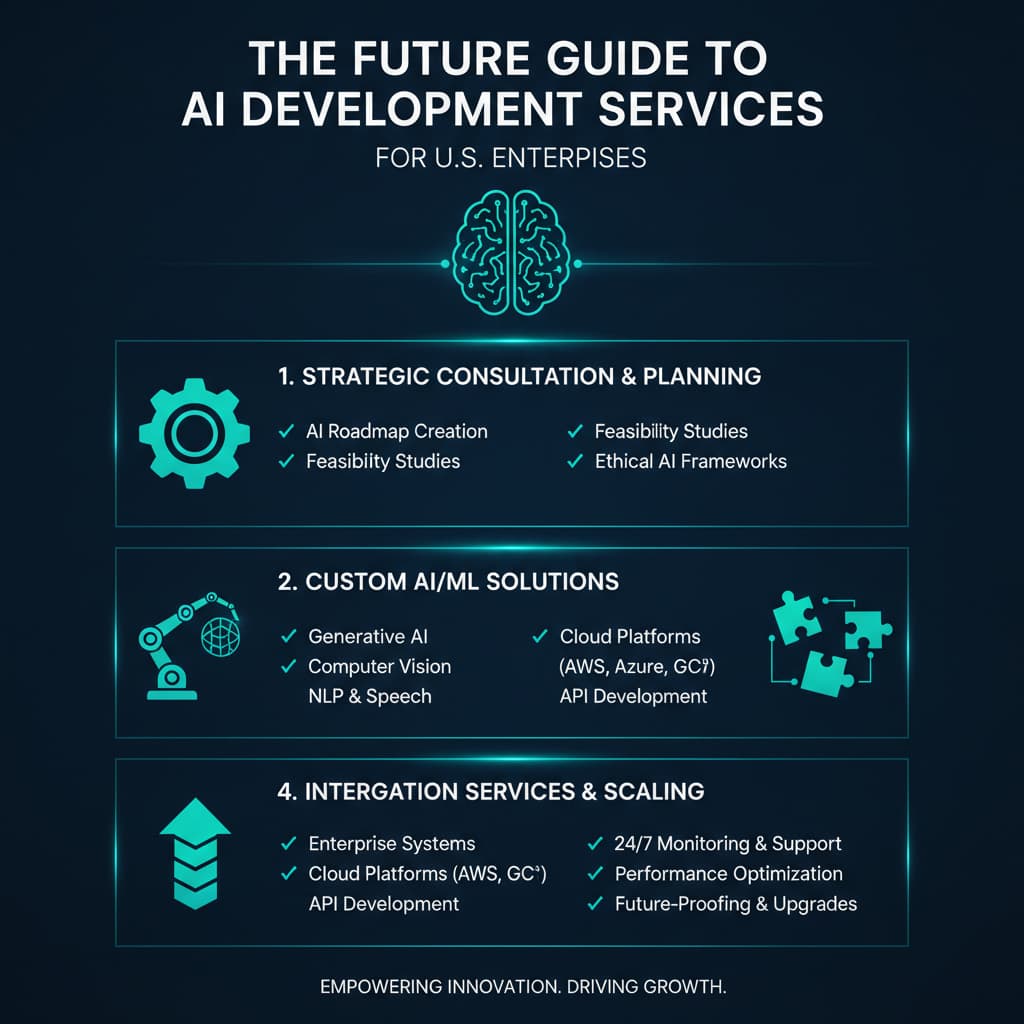
Navigating the Future Guide for AI Development Services United States
To explain future guide for AI development services United States clearly for customers, organizations must focus on high-autonomy frameworks that meet rigorous American compliance standards. Choosing a full-lifecycle engineering partner ensures systems are continuously optimized as operational demands scale.
To maximize return on investment, software architecture must adhere to four critical pillars:
- Data Governance & Compliance: Adhering to strict U.S. data sovereignty, privacy rules, and security frameworks.
- Scalability Architecture: Implementing modular interfaces so underlying LLMs or infrastructure components can be swapped cleanly without rewriting front-end applications.
- Human-in-the-Loop Validation: Designing expert verification workflows into critical processes to maintain high accuracy and prevent hallucinations.
- Continuous Monitoring: Deploying real-time MLOps observability to track model latency, performance, and drift.
| Feature Dimension | Legacy IT Outsourcing | Modern AI Development Consultancy |
|---|---|---|
| Primary Focus | Maintenance & Support | Innovation & Custom R&D |
| Integration Style | Bolt-on External Features | Deep Core Architecture Integration |
| Development Methodology | Rigid Waterfall | Agile & Agentic Iteration |
| Outcome Goal | Incremental Cost Reduction | Competitive Advantage & Revenue Generation |
By partnering with specialized enterprise development teams and scaling Custom Mobile Application Development Services alongside advanced predictive architectures, U.S. organizations can ensure long-term agility, security, and market leadership.